
Historical record
This page records what happened on a date, with its observed failures and limits. It is not a requirement for the current implementation. Current behaviour is in Status.
Semantic figures: clades and linked enrichment
Date: 2026-11-07. Stage 1: two native workflows run inside Rho. This is a functional episode, not independent researcher usability evidence or a general SVG converter.
What ran
The optional Semantic figures plugin 0.1.0 supplies its own operations, Skill and HTML view through Rho's existing independent plugin channel. Its adapters/ggtree.R and adapters/enrichplot.R retain domain identities; capture.R, host.mjs and the view share rendering, snapshot reading and conditional selection. Plot families add no application routing branches, base dependencies or Core behavior.
The package was packed with npm pack --ignore-scripts and installed into an owned, disposable Rho service. Capture used the project's shared local R session. No existing user service, R session or project was changed.
| Input | Native output | Observed selection |
|---|---|---|
ape::bird.orders, 23 bird orders | ggtree rectangular and circular layouts; 45 point bindings each | One five-tip clade retains exactly the same members across layouts and reopening |
DOSE::geneList, positive values greater than 2; declared background of all named genes | clusterProfiler GO BP enrichment with 156 visible terms; enrichplot shows the first three, with 17 genes and 20 network nodes | A term selects its 14 contributing genes; shared gene 55143 links back to all three displayed terms |
The enrichment is a demonstration, not a new biological finding. The recipe uses ENTREZID, GO BP, gene sets of size 10–100, BH adjustment, p-value cutoff 0.05 and q-value cutoff 0.2. The source enrichResult, source bytes, analysis conditions, package versions and ordinary result table are retained. The preparation script keeps these dataset choices outside the reusable plugin.
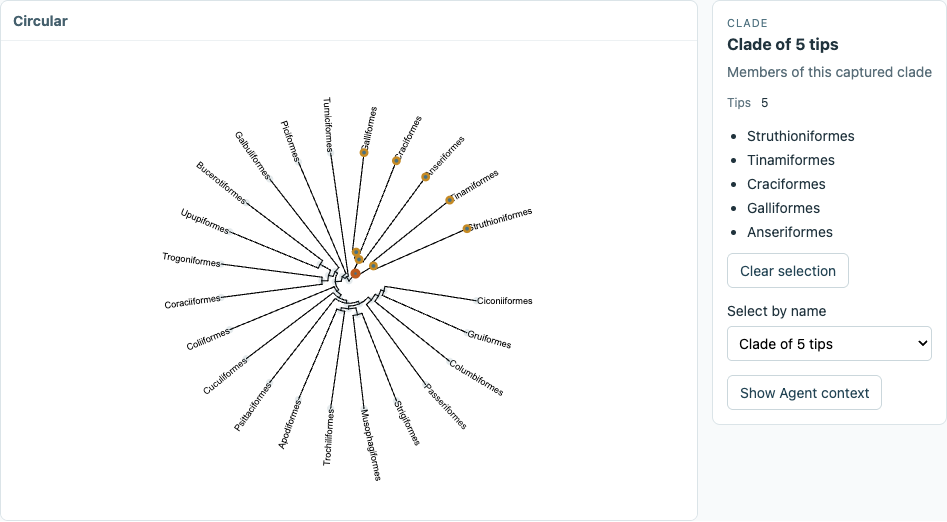
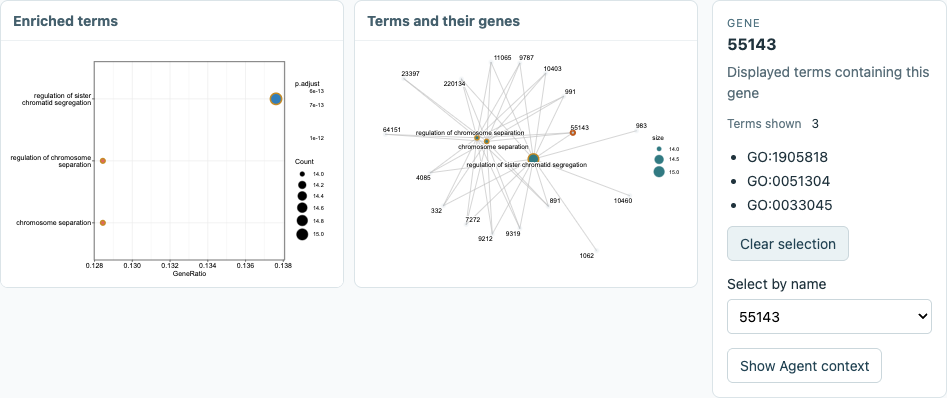
These are captures of the plugin's actual view inside Rho, excluding the package management controls. They are not a separate mockup.
Iterations and causes
The first native probe produced both families. The first composed capture failed because the adapter inferred its source directory from an R stack frame that was different inside Notebook. The plugin now passes its installed adapter directory explicitly. The original failed cell was retained; a deliberate new capture ran.
The first browser run selected a clade and retained its membership across layout changes, but its SVG cleaner had removed svglite's default stylesheet. Tree lines disappeared, and a decoration rectangle intercepted dotplot clicks. The view now retains bounded native styles without external loads and gives pointer events only to explicitly bound marks. Neither role nor identity is guessed from pixels. Tree label space was increased after the first view clipped tip names.
The next run passed both selection directions. The episode initially expected a stale native selection call to have a failed extension receipt. API 1 reports worker errors as unknown, even for this explicit pre-write refusal. The check now preserves that receipt state, checks the conflict message and independently reads the unchanged selection. Harness retries also toggled an already-open capture form closed. Child visibility proved unreliable during a viewport transition; the check now reads the details element's open state after settling.
Final review found that a selection reply arriving after a figure switch could change the new view's local selection. Replies now stay with their requesting figure; a browser check holds the real reply while switching figures. Native capture also restores the shared R random state, including an originally absent seed, so the network layout's seed does not affect subsequent analysis.
Concurrent unrelated plugin-interface edits appeared in the Rho working checkout. The final composition was therefore rebuilt from clean Rho source e2345c599d6f7a6aca543efe64dae112aae1edd2 in a detached verification checkout, with base Plugins source b451e8df8361bc0ff95e9b037c22b10cb754587d and the explicitly installed new plugin. Exploratory shell-layout edits were not delivered as part of this episode; the concurrent work was preserved. No application runtime change is required to install or use this plugin.
Verification
The retained machine record identifies the installed package digest, source and figure digests, native versions, checks and viewport observations. Local private service state and full-page screenshots stay under ignored work/semantic-figures/; public captures contain package example data.
- Clean verification-checkout
npm run build: passed. Existing bundle-size, browser externalization and mixed-import warnings remained. - Owner
node --test test/semantic-figures.test.mjs: 5/5 passed, covering captured source identity, conditional writes, concurrent selection, containment and source limits, and preservation of the original submitted cell. node scripts/semantic-figures-episode.mjs: passed using real R and Chrome. It checks tree selection/layout change, reopening, term-to-gene and keyboard gene-to-term linkage, the Agent-readable selection response, a stale write, a delayed reply after switching figures, R random-state restoration, invalid R-object input followed by corrected capture, and changed-source notice.- The view was exercised at 1440, 1024, 768 and 390 CSS px. Its body did not overflow horizontally. Screenshots were read, including settled captures after viewport transitions; a separate retained-figure read started no R cell.
Native versions included R 4.5.2, ggtree 4.0.1, ape 5.8.1, ggplot2 4.0.3.9000, enrichplot 1.30.4 and clusterProfiler 4.18.4. The last was installed in a private episode library and reports that its binary was built under R 4.5.3. ggtree also emitted four subgroup column warnings per capture; these remain in the record.
To repeat from a built Rho checkout, with the component checkout beside it:
RHO_FIGURE_R_LIBRARY=/absolute/existing/R-library \
  node scripts/semantic-figures-episode.mjs
The variable is optional if prerequisites are already installed. An existing prepared episode project can be reused with RHO_FIGURE_INPUT to avoid refitting. RHO_FIGURE_EPISODE selects a fresh output directory. --keep keeps the owned trial service open until interrupted. The default closes only its own service and browser and retains output files. No npm or application release is performed.
What the screens show, and what remains
The circular tree and its five-member list can be read together; the selection survives layout changes without recomputing the tree. The enrichment inspector names the selected term, adjusted p-value, ratio and contributing genes. The reverse selection identifies exactly which displayed terms contain a gene.
The host currently places independent views under Plugins, below management information, inside a scrolling frame. The 1440 px view gives each enrichment plot about 342 px, so native labels are small; at narrower widths the inspector and plots stack and require scrolling. These are concrete composition/readability limitations, despite passing interaction assertions. Studio placement and a better use of plot space remain follow-up work; no usability claim is made.
Bindings currently cover point handles only: tree clade nodes, enrichment term points and network nodes. Network edges and text are not independently selectable. The tree adapter accepts phylo; the enrichment adapter accepts ORA enrichResult. Existing decorated ggtree objects, GSEA, compareCluster, remote capture and ComplexHeatmap are not supported by this first package.
Selection context is available through the plugin's ordinary operations. No model was asked to interpret it, and it is not automatically inserted into Agent-panel messages. A layout change retains one snapshot; topology or result changes create a new capture. Automatic semantic migration, layered claims and persistent explanations are not yet implemented. Resource limits and exceeded-limit behavior are documented by the component owner.