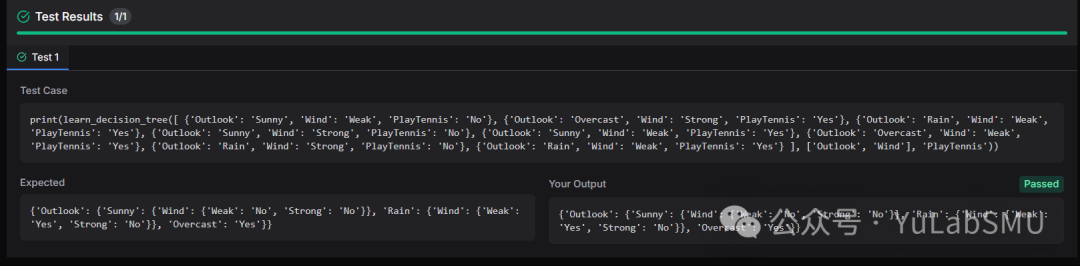
Write a Python function that implements the decision tree learning algorithm for classification. The function should use recursive binary splitting based on entropy and information gain to build a decision tree. It should take a list of examples (each example is a dict of attribute-value pairs) and a list of attribute names as input, and return a nested dictionary representing the decision tree.
Example:
Input:
examples = [
                    {'Outlook': 'Sunny', 'Temperature': 'Hot', 'Humidity': 'High', 'Wind': 'Weak', 'PlayTennis': 'No'},
                    {'Outlook': 'Sunny', 'Temperature': 'Hot', 'Humidity': 'High', 'Wind': 'Strong', 'PlayTennis': 'No'},
                    {'Outlook': 'Overcast', 'Temperature': 'Hot', 'Humidity': 'High', 'Wind': 'Weak', 'PlayTennis': 'Yes'},
                    {'Outlook': 'Rain', 'Temperature': 'Mild', 'Humidity': 'High', 'Wind': 'Weak', 'PlayTennis': 'Yes'}
                ],
                attributes = ['Outlook', 'Temperature', 'Humidity', 'Wind']
Output:
{
            'Outlook': {
                'Sunny': {'Humidity': {'High': 'No', 'Normal': 'Yes'}},
                'Overcast': 'Yes',
                'Rain': {'Wind': {'Weak': 'Yes', 'Strong': 'No'}}
            }
        }
这道题要写一个决策树,决策树的构建采用递归分裂方法,核心步骤包括:
- 选择最佳分裂特征(基于信息增益、基尼系数等)
- 按特征划分数据集
- 递归构建子树,直到满足停止条件
首先是第一步,题目使用的是信息增益: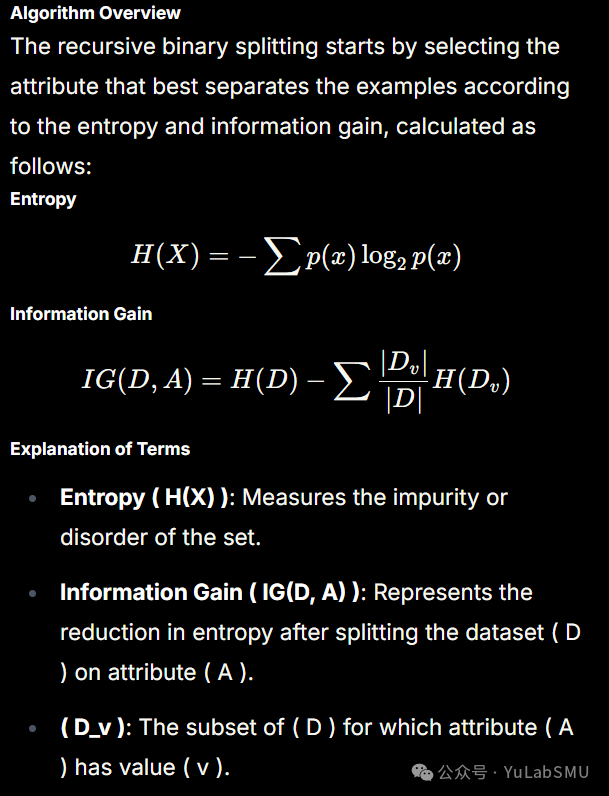
那么我们首先要定义函数来计算信息熵:
import math

def counter(labels):
    counts = {}
    for x in labels:
        if x notin counts:
            counts[x] = 0
        counts[x] += 1
    return counts

def entropy_item(x, total):
    p = x / total
    return p * math.log2(p)

def calculate_entropy(labels):
    lab_cnt = counter(labels)
    tot_cnt = len(labels)
    entropy = -sum(entropy_item(count, tot_cnt) for count in lab_cnt.values())
    return entropy
然后是定义函数来计算信息增益:
def get_attr_val(examples, attr):
    return [example[attr] for example in examples]

def get_unique_vals(examples, attr):
    return set(get_attr_val(examples, attr))

def get_subset(examples, attr, value):
    return [example for example in examples if example[attr] == value]

def calculate_information_gain(examples, attr, target_attr):
    targets = get_attr_val(examples, target_attr)
    total_entropy = calculate_entropy(targets)
    values = get_unique_vals(examples, attr)
    attr_entropy = 0

    for value in values:
        subset = get_subset(examples, attr, value)
        entropy = calculate_entropy(get_attr_val(subset, target_attr))
        attr_entropy += (len(subset) / len(examples)) * entropy

    return total_entropy - attr_entropy
有了信息增益函数,就可以通过它来得到最佳分裂特征,然后按照此特征切分数据,进行递归,重复这一过程,直到退出。
def majority(examples, target_attr):
    x = counter(get_attr_val(examples, target_attr))
    return max(x, key=x.get)

def learn_decision_tree(examples, attributes, target_attr):
    ifnot examples:
        return'No examples'
    targets = get_unique_vals(examples, target_attr)
    if len(targets) == 1:
        return list(targets)[0]
    ifnot attributes:
        return majority(examples, target_attr)

    gains = {attr: calculate_information_gain(examples, attr, target_attr) for attr in attributes}
    best_attr = max(gains, key=gains.get)
    tree = {best_attr: {}}

    for val in get_unique_vals(examples, best_attr):
        subset = get_subset(examples, best_attr, val)
        new_attributes = attributes.copy()
        new_attributes.remove(best_attr)
        subtree = learn_decision_tree(subset, new_attributes, target_attr)
        tree[best_attr][val] = subtree

    return tree